Online chord finder: chord house ::: piano room: chords and scales
- Print Autumn Leaves.
- To save time, first note the repeated harmonic progressions. (Most chords reappear in this song.)
- Left Hand (bass staff)
- Write only half notes. (This will produce a smooth walking bass.)
- On every downbeat, write the root of the chord.
- In the middle of the bar, write the fifth of the chord—unless the measure has two chords, then simply write both chord roots.
- Keep the bass line low, from the bottom of the bass staff down to even a ledger line or two below the staff.
- Right Hand (treble staff)
- Complete the chords below the right hand melody.
- You will usually add 2 notes.
- Make certain the 3rd and 7th are present either in the melody or your chords.
(The chord root will be in the bass. The fifth may be omitted unless it is altered.) - Your right hand should be able to play both the melody and the chords.
- Play it if you can—slowly. (You do not need to submit a recording.)
- Take a picture of your written work and place the file in D2L (Assessments - Dropbox - Play a Lead Sheet).
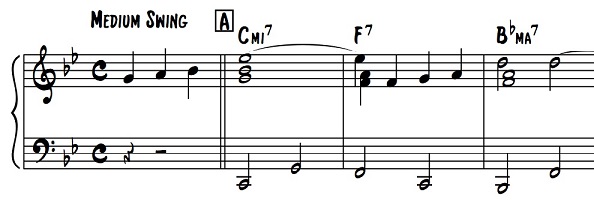
I began with the melody alone for the pickup notes.
The left hand is all half notes at the bottom of the bass staff—the root of the chord on the downbeat followed by the fifth of the chord.
On the first downbeat, my right hand adds a G and B flat because the bass has the C and the melody is E flat.
Next, I only added quarter notes so that my chord tones do not obscure the melody.